
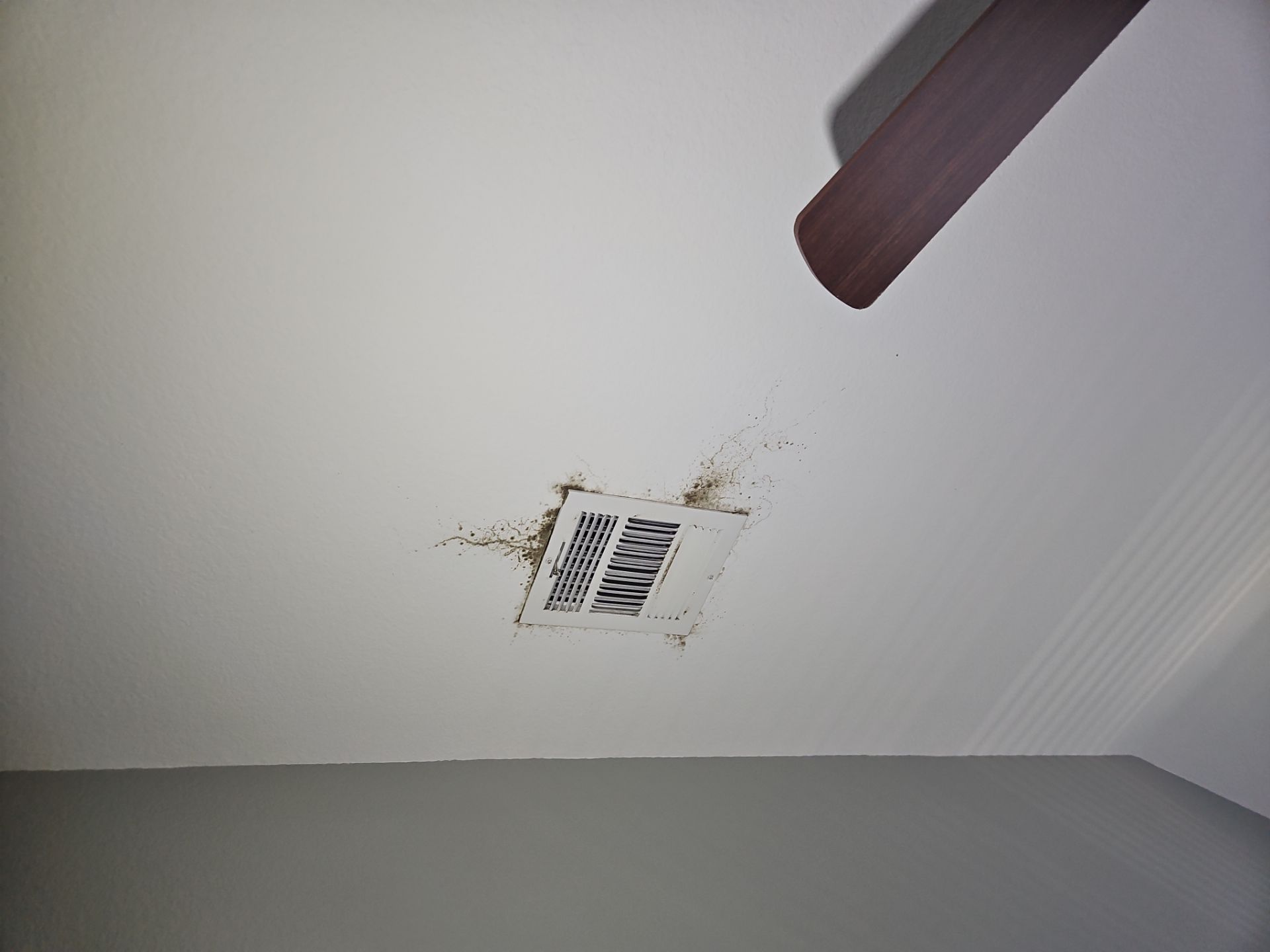
Most homeowners picture a leak or a flood when they think about mold from humidity Melissa TX. But some of the most stubborn mold problems have no leak at all. Humidity causes them instead, and humidity is often a symptom of something most homeowners would never suspect: the air conditioning system itself. This Melissa home is a textbook example. The house was only a few years old, yet mold formed throughout the upstairs and started to appear downstairs. An oversized HVAC system turned out to be the cause, and it quietly kept the whole home too humid.
What we found in Melissa
The homeowner noticed visible mold spreading across the upstairs, with early signs downstairs as well, and it had worsened quickly. Our team inspected the home and ruled out the usual culprits. There was no leak and no flooding. High indoor humidity from an HVAC system too large for the home’s square footage caused the problem instead. An oversized system cools the air quickly and then shuts off in short cycles. It never runs long enough to pull moisture out of the air, so the home stays humid. Combined with overdue maintenance, that steady humidity created the conditions for mold to grow on surfaces throughout the house.
Why oversized air conditioning causes mold
This part is worth understanding, because it is common and rarely diagnosed. Air conditioning does two jobs: it lowers temperature and it removes moisture. Removing moisture takes runtime. A right-sized system runs in longer, steadier cycles that dehumidify as they cool. An oversized system hits the thermostat target fast, then shuts off, and leaves the humidity behind. The house feels cool but clammy. Over months, that trapped moisture is enough to grow mold with no leak anywhere in sight. Fixing that means correcting the air conditioning, not just cleaning the mold.
How we approached the job
Because the cause was mechanical, Rainy Day brought in a certified HVAC expert and a Mold Assessment Consultant to define the full extent of the problem and build the safest remediation plan. Our team is carrying out that plan in coordination with the homeowner, the HVAC contractor, and the consultant. It addresses both the mold and the humidity driving it.
The remediation plan
The plan follows four coordinated stages. First, assessment and containment: our team isolates the affected areas so mold spores do not spread further through the home. Second, HVAC correction: we adjust the system’s sizing and operation, install an inline dehumidifier, replace select ductwork and registers, and complete the overdue maintenance, so the home stops staying humid. Third, remediation and cleaning: our crew performs targeted heavy cleaning, drywall removal where needed, and applies encapsulation and antimicrobial coatings on affected areas. Fourth, contents cleaning and air quality control: we run HEPA filtration and air scrubbers to keep indoor air safe during the work, along with light contents cleaning.
Why this is the right way to fix humidity mold
The important lesson here is that remediating the mold without correcting the HVAC would waste money. As long as the system keeps the home humid, the mold comes back. Our team fixes the mechanical cause and the humidity at the same time as the visible mold. That approach sets the home up to stay dry going forward rather than to grow mold again next summer. Homeowners should expect that kind of coordination between remediation and the trades that control moisture from a company that treats the cause, not just the symptom.
Guidance for property owners in Melissa and North Texas
If you see mold in a newer home with no obvious leak, do not assume you simply have a mystery. Watch for a house that feels cool but damp, condensation on vents or windows, a musty smell that returns after cleaning, or air conditioning that cycles on and off frequently. Any of these can point to a humidity problem rather than a water problem, and the fix involves an HVAC evaluation alongside the mold work. A professional mold assessment that considers the mechanical systems, not just the surfaces, is the right starting point for mold from humidity Melissa TX cases like this one.
Related guidance
Learn more about our mold remediation services and how we approach the moisture that causes it, or get help now if you are seeing mold in a home without an obvious leak.
Frequently asked questions
Why was there mold from humidity Melissa TX in this home if there was no leak?
A leak or flooding did not cause the mold at all. High indoor humidity from an HVAC system oversized for the home caused it instead. That humidity combined with overdue maintenance to create conditions where mold could grow on surfaces throughout the house.
How does an oversized air conditioning system cause mold?
Air conditioning has to both cool the air and remove moisture, and removing moisture takes runtime. An oversized system cools the home quickly and shuts off in short cycles. It never runs long enough to pull moisture out of the air. That leaves the home cool but humid enough over time for mold to grow.
What is Rainy Day’s plan to fix this mold and humidity problem in Melissa?
Rainy Day brought in a certified HVAC expert and a Mold Assessment Consultant to build a plan that addresses both the mold and its cause. The plan covers four stages: assessment and containment, HVAC correction (including sizing, an inline dehumidifier, and select duct replacement), remediation and cleaning, and contents cleaning with air quality control.
“This team has gone above and beyond to get my home back in working order from day 1. They have been so thorough and explained every step of the process, making an unfortunate situation bearable. Responsive, professional and family owned- I HIGHLY RECOMMEND! ⭐️⭐️⭐️⭐️”